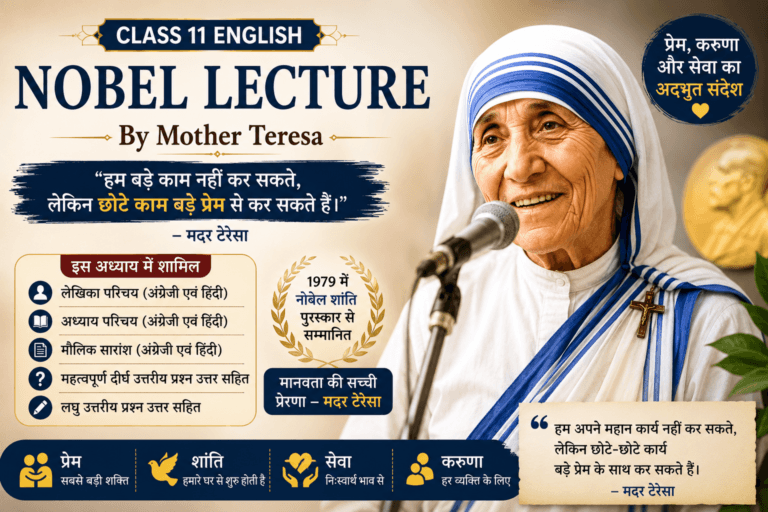

Nobel Lecture – Mother Teresa
(Class 11 English)
About the Author (English)
Mother Teresa (1910–1997) was one of the world’s most respected humanitarians and missionaries. She was born on 26 August 1910 in Skopje (now in North Macedonia). Her original name was Anjezë Gonxhe Bojaxhiu.
At the age of eighteen, she joined the Sisters of Loreto and came to India as a teacher. Later, she felt a special calling from God to serve the poorest and the sick. In 1950, she founded the Missionaries of Charity in Kolkata. The organization dedicated itself to helping the poor, homeless, orphaned, abandoned, and dying people.
Mother Teresa believed that every human being deserves love, dignity, and compassion. She spent her entire life serving those who were neglected by society.
In 1979, she received the Nobel Peace Prize for her selfless service to humanity. Instead of celebrating with a grand banquet, she requested that the prize money be used to feed poor people.
Some of her famous works include:
- A Simple Path
- No Greater Love
- Come Be My Light
Mother Teresa passed away on 5 September 1997, but her message of love, peace, and service continues to inspire millions around the world.
लेखिका परिचय (Hindi)
मदर टेरेसा (1910–1997) विश्व की महान समाजसेविका, मिशनरी और मानवतावादी थीं। उनका जन्म 26 अगस्त 1910 को स्कोप्जे (वर्तमान उत्तर मैसेडोनिया) में हुआ। उनका वास्तविक नाम अंजेज़े गोंझे बोजाक्षियु (Anjezë Gonxhe Bojaxhiu) था।
18 वर्ष की आयु में उन्होंने सिस्टर्स ऑफ लोरेटो संस्था जॉइन की और भारत आईं। प्रारंभ में वे एक शिक्षिका थीं, लेकिन बाद में उन्होंने अपना पूरा जीवन गरीब, बीमार, अनाथ और असहाय लोगों की सेवा के लिए समर्पित कर दिया।
सन् 1950 में उन्होंने Missionaries of Charity की स्थापना कोलकाता में की। इस संस्था का उद्देश्य समाज के सबसे गरीब और उपेक्षित लोगों की सेवा करना था।
मदर टेरेसा का विश्वास था कि हर व्यक्ति ईश्वर की संतान है और प्रत्येक व्यक्ति प्रेम, सम्मान और देखभाल का अधिकारी है।
मानव सेवा के लिए उन्हें 1979 में नोबेल शांति पुरस्कार प्रदान किया गया। उन्होंने पुरस्कार राशि भी गरीबों की सहायता के लिए दान कर दी।
उनका निधन 5 सितंबर 1997 को हुआ, लेकिन उनका प्रेम, करुणा और सेवा का संदेश आज भी पूरी दुनिया को प्रेरित करता है।
About the Chapter (English)
“Nobel Lecture” is the acceptance speech delivered by Mother Teresa after receiving the Nobel Peace Prize in 1979.
In her speech, she explains that the greatest threat to the world is not hunger or war alone, but the absence of love, compassion, and care for one another.
Mother Teresa says that peace begins at home. If people love and respect their own family members, society will naturally become peaceful. She emphasizes that even a small act of kindness can bring great happiness.
She encourages people to help the poor, the lonely, the abandoned, and the unwanted. According to her, the greatest poverty is not the lack of money but the feeling of being unloved and unwanted.
The lecture teaches universal values such as love, peace, kindness, forgiveness, and selfless service. It reminds readers that everyone can make the world a better place through simple acts of compassion.
अध्याय परिचय (Hindi)
“Nobel Lecture” मदर टेरेसा द्वारा 1979 में नोबेल शांति पुरस्कार प्राप्त करने के अवसर पर दिया गया भाषण है।
इस भाषण में वे बताती हैं कि दुनिया की सबसे बड़ी समस्या केवल गरीबी या युद्ध नहीं है, बल्कि प्रेम, करुणा और अपनापन की कमी है।
वे कहती हैं कि शांति की शुरुआत हमारे अपने घर से होती है। यदि परिवार के सदस्य एक-दूसरे से प्रेम करेंगे, तो समाज और दुनिया भी शांतिपूर्ण बनेगी।
मदर टेरेसा लोगों से गरीबों, बीमारों, अकेले और असहाय लोगों की सेवा करने का आग्रह करती हैं। उनके अनुसार सबसे बड़ी गरीबी धन की कमी नहीं, बल्कि अकेलापन, उपेक्षा और प्रेम का अभाव है।
यह अध्याय प्रेम, दया, सेवा, क्षमा और मानवता का संदेश देता है तथा हमें सिखाता है कि छोटी-छोटी अच्छाइयाँ भी दुनिया में बड़ा परिवर्तन ला सकती हैं।
Original Summary (English) (Copyright-Free & Human Written)
Mother Teresa’s Nobel Lecture is a powerful message of love, peace, and compassion. After receiving the Nobel Peace Prize, she uses the opportunity not to speak about herself but to speak about the suffering of poor and neglected people.
She explains that many people think poverty only means the lack of food, clothes, or shelter. However, she believes that the greatest poverty is loneliness and the feeling of being unwanted. According to her, many people in wealthy countries suffer from this kind of emotional poverty.
Mother Teresa says that peace begins in our own homes. Families should love, forgive, and care for one another. A smile, a kind word, or a helping hand can bring happiness to someone who is suffering.
She also speaks against violence, hatred, and selfishness. She believes that every human life is precious because every person is created by God. Helping even one person with love is a great service to humanity.
The lecture encourages people not to wait for big opportunities to do good. Instead, they should begin with small acts of kindness in their daily lives.
Mother Teresa’s message is simple yet powerful: love others without expecting anything in return, and the world will become a more peaceful place.
मौलिक सारांश (Hindi) (कॉपीराइट-फ्री एवं सरल भाषा में)
“Nobel Lecture” मदर टेरेसा का एक प्रेरणादायक भाषण है जिसमें उन्होंने प्रेम, शांति और मानव सेवा का संदेश दिया है।
नोबेल पुरस्कार प्राप्त करने के बाद उन्होंने अपने सम्मान की बात करने के बजाय गरीबों, बीमारों, अकेले और असहाय लोगों की समस्याओं पर ध्यान आकर्षित किया।
वे बताती हैं कि लोग अक्सर गरीबी का अर्थ केवल भोजन, कपड़े या पैसे की कमी समझते हैं, लेकिन वास्तव में सबसे बड़ी गरीबी वह है जब कोई व्यक्ति स्वयं को अकेला, उपेक्षित और प्रेम से वंचित महसूस करता है।
मदर टेरेसा कहती हैं कि शांति की शुरुआत परिवार से होती है। यदि परिवार के सदस्य एक-दूसरे से प्रेम करें, क्षमा करें और एक-दूसरे का सम्मान करें, तो पूरा समाज शांतिपूर्ण बन सकता है।
वे लोगों से आग्रह करती हैं कि वे छोटी-छोटी दयालुता और सेवा के कार्य करें। किसी भूखे को भोजन देना, किसी दुखी व्यक्ति को सांत्वना देना, किसी अकेले व्यक्ति के साथ समय बिताना—ये सभी कार्य मानवता की सच्ची सेवा हैं।
उनके अनुसार प्रत्येक मनुष्य ईश्वर की अनमोल रचना है। इसलिए हमें बिना किसी भेदभाव के सभी से प्रेम करना चाहिए।
यह भाषण हमें सिखाता है कि दुनिया को बदलने के लिए बड़े कार्यों की आवश्यकता नहीं होती। यदि प्रत्येक व्यक्ति अपने घर और समाज में प्रेम, करुणा और सेवा का भाव अपनाए, तो पूरी दुनिया अधिक सुखी और शांतिपूर्ण बन सकती है।
Nobel Lecture – Mother Teresa (Class 11 English)
Important Long Questions with Answers
1. What is the central message of Mother Teresa’s Nobel Lecture? Explain in detail. (6 Marks)
Answer:
The central message of Mother Teresa’s Nobel Lecture is love, peace, compassion, and selfless service.
Mother Teresa believes that the greatest problem in the world is not only hunger or poverty but also the lack of love and care. Many people suffer because they feel lonely, unwanted, and forgotten. According to her, true peace begins in our own homes. If family members love, respect, and forgive one another, peace will naturally spread to society and the world.
She encourages everyone to perform small acts of kindness, such as feeding the hungry, helping the sick, comforting the lonely, and showing love to everyone without discrimination. She says that we do not need to do great things; even small actions done with great love can change the world.
Thus, the lecture teaches that love is the strongest force for creating peace and happiness.
2. Why does Mother Teresa say that the greatest poverty is not the lack of food but the lack of love? Explain. (6 Marks)
Answer:
Mother Teresa explains that physical poverty can be reduced by providing food, clothes, and shelter. However, emotional poverty is much more painful because it cannot easily be removed.
According to her, many people in rich countries have enough money but still feel lonely, rejected, and unloved. They suffer from the pain of being unwanted by their families or society.
She believes that everyone needs love, care, and respect more than material wealth. A person who has food but no love is still poor in heart.
Therefore, Mother Teresa says that the greatest poverty is loneliness and the feeling of being unwanted, and the best way to remove it is through kindness and compassion.
3. How does Mother Teresa explain that peace begins at home? (6 Marks)
Answer:
Mother Teresa believes that peace does not begin in governments or international organizations. It begins in every family.
If parents love their children, children respect their parents, and family members forgive one another, homes become peaceful. Peaceful families create peaceful communities, and peaceful communities build peaceful nations.
She advises people to smile at each other, spend time with family members, and care for those who feel lonely.
According to Mother Teresa, many social problems can be solved if people first learn to love those who live closest to them.
Thus, she concludes that the foundation of world peace is love within the family.
4. What qualities of Mother Teresa are reflected in her Nobel Lecture? (6 Marks)
Answer:
Mother Teresa’s Nobel Lecture reflects many noble qualities.
She was kind, humble, compassionate, selfless, forgiving, and deeply devoted to humanity.
Instead of speaking about her own achievements after receiving the Nobel Prize, she focused on the suffering of poor and lonely people.
She believed in serving others without expecting anything in return. She respected every human life equally and encouraged people to help those who were neglected by society.
Her speech also shows her deep faith in God and her belief that love is the greatest gift anyone can offer.
These qualities made her one of the greatest humanitarians in history.
5. What lessons do you learn from Mother Teresa’s Nobel Lecture? (6 Marks)
Answer:
Mother Teresa’s Nobel Lecture teaches many valuable life lessons.
It teaches us to love everyone without discrimination and to help those who are poor, sick, lonely, and helpless.
The lecture reminds us that peace starts from our own family and that even a small act of kindness can bring happiness to others.
It also teaches us that money alone cannot make people happy. Love, compassion, forgiveness, and care are more valuable than wealth.
Finally, the lecture inspires us to become responsible citizens who spread kindness and humanity wherever we go.
6. Explain the importance of love and compassion in Mother Teresa’s Nobel Lecture. (6 Marks)
Answer:
Love and compassion are the main themes of Mother Teresa’s Nobel Lecture.
She believes that every human being deserves love, respect, and dignity because all people are children of God.
According to her, helping the poor is not enough unless it is done with genuine love. Even a smile, a kind word, or a caring touch can make someone feel valued.
Mother Teresa says that hatred, violence, and selfishness disappear when people learn to love one another.
Therefore, she encourages everyone to practise kindness in daily life and make the world a better place through compassion.
Short Questions with Answers
1. Who delivered the Nobel Lecture?
Answer:
The Nobel Lecture was delivered by Mother Teresa after receiving the Nobel Peace Prize in 1979.
2. When did Mother Teresa receive the Nobel Peace Prize?
Answer:
She received the Nobel Peace Prize in 1979.
3. According to Mother Teresa, where does peace begin?
Answer:
According to Mother Teresa, peace begins at home.
4. What is the greatest poverty according to Mother Teresa?
Answer:
The greatest poverty is being unwanted, unloved, and lonely.
5. Whom did Mother Teresa dedicate her life to serving?
Answer:
She dedicated her life to serving the poor, sick, homeless, orphaned, abandoned, and dying people.
6. What is the main message of the Nobel Lecture?
Answer:
The main message is to spread love, peace, compassion, forgiveness, and selfless service.
7. Why is a smile important according to Mother Teresa?
Answer:
A smile is a simple expression of love that can bring hope, happiness, and comfort to another person.
8. What kind of service does Mother Teresa encourage?
Answer:
She encourages selfless service with love, kindness, and compassion, without expecting any reward.
9. What does Mother Teresa say about love?
Answer:
She says that love is the greatest gift and that small acts done with great love can change the world.
10. What is the overall theme of the Nobel Lecture?
Answer:
The overall theme is humanity, love, peace, compassion, and the importance of serving others with a selfless heart.
Nobel Lecture – Mother Teresa (Class 11 English)
Insight Check
A. Answer the following briefly
1. What was the reaction of the rescued lady before her death? (2 Marks)
Answer:
The rescued lady smiled peacefully before her death. She held Mother Teresa’s hand and simply said “Thank you.” Even in her last moments, she expressed gratitude instead of complaining about her suffering. This deeply touched Mother Teresa and showed the power of love and compassion.
2. What did Mother intend to do with the prize money? (2 Marks)
Answer:
Mother Teresa intended to use the Nobel Peace Prize money to help the poor and hungry. She wanted to provide food, shelter, and care for those who were suffering instead of spending the money on celebrations or personal comforts.
Delve Deep
1. What did Mother Teresa observe in an old age home that she visited? (6 Marks)
Answer:
Mother Teresa observed that the old age home had all the necessary facilities. The elderly people had comfortable beds, good food, clean rooms, medical care, and every physical comfort. However, despite having everything, they were unhappy.
She noticed that all of them kept looking towards the door, hoping that someone from their family would come to visit them. Their faces showed sadness, loneliness, and disappointment because they felt abandoned by their own children.
Mother Teresa realized that the greatest suffering was not the lack of material things but the absence of love and care. She believed that emotional loneliness is a much deeper form of poverty than financial poverty.
Through this incident, she taught that people should not neglect their parents and elderly family members. Love, respect, and companionship are more valuable than wealth.
2. “I had the most extraordinary experience with the Hindu family that had eight children.” Which experience is Mother Teresa speaking of? (6 Marks)
Answer:
Mother Teresa narrates the touching story of a poor Hindu family with eight children who had no food for several days. She took some rice to help them because they were starving.
As soon as the mother received the rice, she immediately divided it into two equal parts. She then went to her Muslim neighbours and shared half of the rice with them because she knew that they were also hungry.
Mother Teresa was deeply moved by this act of generosity. Even though the Hindu family itself had very little to eat, they did not hesitate to share their food with another needy family belonging to a different religion.
This experience taught Mother Teresa that true love, kindness, and humanity rise above religion, caste, and poverty. Real generosity comes from the heart, not from wealth.
The incident perfectly reflects the values of compassion, sharing, and communal harmony that Mother Teresa wanted to spread through her Nobel Lecture.
notice : इस article लिखने के लिए हमने west bengal sylabus के class -11 English की पुस्तक का help लिए। हमारा उद्देश्य केवल छात्रों को शिक्षित करना है। Google से गुजारिश है हमारे post को रैंक करे और छात्रों को शिक्षित करने में हमारी मदद करे।