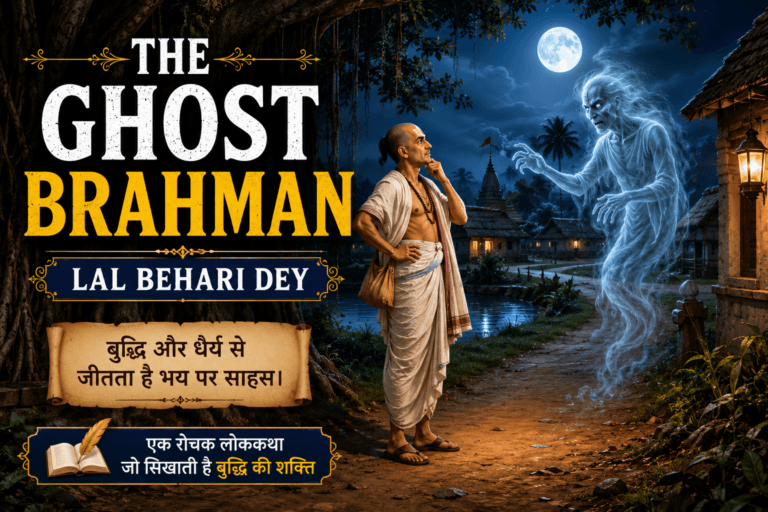

The Ghost Brahman – Lal Behari Dey
(Class 11 English)
✅ About the Author (English)
Lal Behari Dey (1824–1892) was an Indian writer, journalist, educator, and social reformer. He was born in 1824 in Bengal, India. He is remembered for collecting and preserving traditional Bengali folk tales and presenting them to English readers.
Lal Behari Dey studied at Bishop’s College, Calcutta, and later became a Christian missionary, teacher, and journalist. His writings introduced the richness of Indian folklore and rural life to the world.
His language is simple, engaging, and filled with moral values. He believed that folk tales are an important part of India’s cultural heritage.
Some of his famous works include:
- Folk-Tales of Bengal
- Bengal Peasant Life (Govinda Samanta)
Lal Behari Dey remains one of the pioneers of Indian writing in English.
✅ लेखक परिचय (Hindi)
लाल बिहारी डे (1824–1892) भारत के प्रसिद्ध लेखक, पत्रकार, शिक्षक और समाज सुधारक थे। उनका जन्म 1824 में बंगाल में हुआ था।
वे विशेष रूप से बंगाल की लोककथाओं (Folk Tales) को संग्रहित करने और उन्हें अंग्रेज़ी भाषा के माध्यम से विश्वभर में पहुँचाने के लिए प्रसिद्ध हैं।
उन्होंने कोलकाता के Bishop’s College में शिक्षा प्राप्त की। बाद में वे शिक्षक, पत्रकार और लेखक बने।
उनकी कहानियों में भारतीय ग्रामीण जीवन, लोकविश्वास, हास्य, नैतिक शिक्षा और संस्कृति का सुंदर चित्रण मिलता है।
उनकी प्रमुख रचनाएँ हैं—
- Folk-Tales of Bengal
- Bengal Peasant Life (Govinda Samanta)
आज भी उन्हें भारतीय अंग्रेज़ी साहित्य के प्रारम्भिक लेखकों में सम्मानपूर्वक याद किया जाता है।
✅ About the Chapter (English)
The Ghost Brahman is a humorous Bengali folk tale collected by Lal Behari Dey.
The story tells about a clever Brahmin who encounters a ghost. Instead of becoming frightened, he uses his intelligence and presence of mind to escape from danger.
The tale is full of humour, suspense, and clever tricks. It highlights the importance of wisdom over physical strength and teaches that intelligence can help people overcome difficult situations.
As a traditional folk tale, it also reflects the beliefs, customs, and imagination of rural Bengal.
✅ अध्याय परिचय (Hindi)
The Ghost Brahman लाल बिहारी डे द्वारा संकलित एक प्रसिद्ध बंगाली लोककथा है।
इस कहानी में एक चतुर ब्राह्मण का वर्णन है, जिसका सामना एक भूत से होता है। लेकिन वह डरने के बजाय अपनी बुद्धिमानी और सूझ-बूझ से स्वयं को बचा लेता है।
कहानी में हास्य, रोमांच और लोकविश्वास का सुंदर मिश्रण है।
यह कहानी सिखाती है कि बल से अधिक बुद्धि शक्तिशाली होती है और कठिन परिस्थितियों में धैर्य तथा समझदारी सबसे बड़ा हथियार है।
✅ Original Summary (English)
The Ghost Brahman is an entertaining folk tale about intelligence and courage.
A Brahmin is travelling alone when he comes across a ghost. The ghost intends to trouble him, but the Brahmin remains calm and thinks carefully.
Using his quick wit and clever words, he confuses the ghost and makes it believe something that is not true. As a result, the ghost becomes frightened and leaves him alone.
The Brahmin safely escapes without using force or violence.
The story shows that wisdom, confidence, and presence of mind are often more powerful than physical strength.
✅ मौलिक सारांश (Hindi)
The Ghost Brahman एक रोचक और हास्यपूर्ण लोककथा है।
कहानी में एक ब्राह्मण यात्रा के दौरान एक भूत से मिलता है। भूत उसे डराना चाहता है, लेकिन ब्राह्मण घबराता नहीं।
वह अपनी बुद्धिमानी और चतुराई का उपयोग करके भूत को उलझा देता है। उसकी समझदारी के कारण भूत स्वयं डर जाता है और वहाँ से भाग जाता है।
इस प्रकार ब्राह्मण बिना किसी लड़ाई के सुरक्षित बच निकलता है।
यह कहानी हमें सिखाती है कि कठिन परिस्थितियों में साहस, धैर्य और बुद्धिमानी सबसे बड़ी शक्ति होती है।
✅ Important Long Questions with Answers
1. Explain how the Brahman defeats the ghost through intelligence rather than strength. (6 Marks)
Answer:
The Brahman is not physically stronger than the ghost, but he is calm, wise, and intelligent.
When he faces the ghost, he does not panic. Instead, he carefully thinks of a clever plan. By speaking confidently and using his presence of mind, he confuses the ghost and makes it believe something false.
The ghost becomes frightened and finally leaves without harming the Brahman.
The story proves that intelligence and courage are often more powerful than physical strength.
2. What are the major themes of The Ghost Brahman? (6 Marks)
Answer:
The story presents several important themes.
The first theme is the victory of intelligence over physical power.
Another important theme is courage. The Brahman remains fearless even in danger.
The story also highlights the importance of presence of mind, showing that quick thinking can solve difficult problems.
Finally, the story reflects traditional Bengali folklore and teaches valuable moral lessons through humour and entertainment.
3. What moral lesson do you learn from The Ghost Brahman? (6 Marks)
Answer:
The story teaches that intelligence is more valuable than physical strength.
It encourages readers to remain calm during difficult situations and to solve problems with wisdom instead of violence.
The Brahman’s courage and confidence show that fear can often be overcome by positive thinking and quick decision-making.
The story also teaches honesty, patience, and self-confidence.
4. Why is The Ghost Brahman considered a folk tale? (6 Marks)
Answer:
The Ghost Brahman is considered a folk tale because it is based on traditional stories passed down from one generation to another.
It includes supernatural elements such as a ghost, simple village settings, humour, and moral lessons.
The language is easy to understand, and the story reflects the customs, beliefs, and imagination of rural Bengal.
These features make it a classic example of Bengali folklore.
✅ Short Questions with Answers
1. Who wrote The Ghost Brahman?
Answer:
The Ghost Brahman was collected and written by Lal Behari Dey.
2. Who is the main character of the story?
Answer:
The main character is a clever Brahman.
3. Whom does the Brahman meet?
Answer:
The Brahman meets a ghost during his journey.
4. How does the Brahman save himself?
Answer:
He saves himself by using his intelligence, confidence, and presence of mind.
5. What does the ghost symbolize?
Answer:
The ghost symbolizes fear, danger, and the unknown.
6. What is the main theme of the story?
Answer:
The main theme is the victory of wisdom over strength.
7. What type of story is The Ghost Brahman?
Answer:
It is a folk tale.
8. What lesson does the story teach?
Answer:
The story teaches that courage, wisdom, and quick thinking help us overcome difficult situations.
✅ Additional Important Long Questions
- Explain the role of humour in The Ghost Brahman.
- Describe the character of the Brahman.
- How does the story reflect Bengali folk culture?
- Why is presence of mind important in difficult situations?
- Explain the importance of intelligence in the story.
✅ Additional Short Questions
- Where does the story take place?
- Why was the ghost unable to harm the Brahman?
- What qualities of the Brahman impressed you most?
- Why are folk tales important?
- What is the central message of the story?
The Ghost Brahman – 50 MCQs with Answers
1. Who wrote The Ghost Brahman?
A) Rabindranath Tagore
B) Premchand
C) Lal Behari Dey
D) R.K. Narayan
Answer: C) Lal Behari Dey
2. What type of story is The Ghost Brahman?
A) Science Fiction
B) Folk Tale
C) Mystery Novel
D) Historical Story
Answer: B) Folk Tale
3. The story belongs to which region of India?
A) Punjab
B) Bengal
C) Gujarat
D) Kerala
Answer: B) Bengal
4. Who is the main character?
A) A King
B) A Merchant
C) A Brahman
D) A Farmer
Answer: C) A Brahman
5. Whom does the Brahman meet?
A) A Tiger
B) A Ghost
C) A King
D) A Saint
Answer: B) A Ghost
6. The ghost wanted to ______.
A) Help the Brahman
B) Frighten the Brahman
C) Teach him
D) Give him money
Answer: B
7. The Brahman saved himself by using—
A) Strength
B) Magic
C) Intelligence
D) Weapons
Answer: C
8. The Brahman remained—
A) Angry
B) Calm
C) Sleepy
D) Lazy
Answer: B
9. The story mainly teaches—
A) Greed
B) Wisdom
C) Revenge
D) Pride
Answer: B
10. The ghost symbolizes—
A) Wealth
B) Fear
C) Knowledge
D) Success
Answer: B
11. The Brahman defeats the ghost through—
A) Violence
B) Cleverness
C) Magic
D) Luck
Answer: B
12. The story belongs to—
A) Modern Fiction
B) Bengali Folklore
C) Drama
D) Poetry
Answer: B
13. The language of the story is—
A) Difficult
B) Simple
C) Scientific
D) Technical
Answer: B
14. Which quality helps the Brahman?
A) Pride
B) Patience
C) Fear
D) Laziness
Answer: B
15. The Brahman uses his—
A) Sword
B) Intelligence
C) Horse
D) Army
Answer: B
16. The ghost becomes—
A) Happy
B) Frightened
C) Angry forever
D) Rich
Answer: B
17. The Brahman finally—
A) Dies
B) Escapes safely
C) Becomes king
D) Runs away crying
Answer: B
18. The story gives a lesson about—
A) War
B) Courage
C) Business
D) Politics
Answer: B
19. Folk tales are generally—
A) Scientific reports
B) Traditional stories
C) Newspapers
D) Essays
Answer: B
20. Lal Behari Dey collected—
A) Bengali Folk Tales
B) Fairy Tales
C) Greek Stories
D) Roman Stories
Answer: A
21. The story encourages—
A) Violence
B) Wisdom
C) Greed
D) Dishonesty
Answer: B
22. The Brahman is—
A) Foolish
B) Intelligent
C) Cruel
D) Selfish
Answer: B
23. The ghost represents—
A) Kindness
B) Danger
C) Success
D) Friendship
Answer: B
24. The Brahman’s greatest strength is—
A) Muscles
B) Mind
C) Money
D) Power
Answer: B
25. The story is—
A) Humorous
B) Sad
C) Romantic
D) Tragic
Answer: A
26. Presence of mind means—
A) Quick thinking
B) Sleeping
C) Fighting
D) Running
Answer: A
27. The Brahman never—
A) Travels
B) Panics
C) Speaks
D) Walks
Answer: B
28. The story reflects—
A) Bengali culture
B) Japanese culture
C) Roman culture
D) French culture
Answer: A
29. The story teaches us to—
A) Fear everything
B) Stay calm
C) Give up
D) Lie always
Answer: B
30. The ghost finally—
A) Wins
B) Leaves
C) Sleeps
D) Laughs
Answer: B
31. The Brahman wins because of—
A) Luck
B) Wisdom
C) Wealth
D) Weapons
Answer: B
32. The moral of the story is—
A) Intelligence is stronger than strength.
B) Money is everything.
C) Revenge is necessary.
D) Ghosts always win.
Answer: A
33. The story mainly belongs to—
A) Folklore
B) Biography
C) Autobiography
D) Travel Writing
Answer: A
34. Lal Behari Dey was an—
A) Indian writer
B) American poet
C) French novelist
D) Russian author
Answer: A
35. The Brahman uses—
A) Common sense
B) Magic
C) Sword
D) Army
Answer: A
36. The story is meant to—
A) Entertain and educate
B) Frighten children
C) Teach science
D) Explain history
Answer: A
37. The Brahman shows—
A) Confidence
B) Cowardice
C) Pride
D) Anger
Answer: A
38. The ghost is defeated because—
A) It is weak
B) It is tricked
C) It is old
D) It is blind
Answer: B
39. Which value is highlighted?
A) Honesty
B) Wisdom
C) Patience
D) All of these
Answer: D
40. The story ends—
A) Sadly
B) Happily
C) Tragically
D) Mysteriously
Answer: B
41. The Brahman’s behavior is—
A) Sensible
B) Foolish
C) Careless
D) Arrogant
Answer: A
42. The ghost tries to—
A) Reward the Brahman
B) Scare the Brahman
C) Teach the Brahman
D) Follow the Brahman
Answer: B
43. Which quality should we learn from the Brahman?
A) Fear
B) Confidence
C) Laziness
D) Pride
Answer: B
44. The Brahman finally feels—
A) Safe
B) Sad
C) Angry
D) Worried
Answer: A
45. The lesson of the story is suitable for—
A) Everyone
B) Only children
C) Only adults
D) Only teachers
Answer: A
46. Which literary form is this?
A) Folk Tale
B) Sonnet
C) Epic
D) Drama
Answer: A
47. The ghost fails because—
A) It is careless
B) The Brahman is clever
C) It is weak
D) It runs away
Answer: B
48. The central idea is—
A) Intelligence wins
B) Wealth wins
C) Power wins
D) Magic wins
Answer: A
49. The story encourages readers to—
A) Think wisely
B) Fight everyone
C) Fear ghosts
D) Avoid travelling
Answer: A
50. The best title for the story is—
A) The Clever Brahman
B) The Ghost Brahman
C) The Brave King
D) The Magic Forest
Answer: B
notice : इस article लिखने के लिए हमने west bengal sylabus के class -11 English की पुस्तक का help लिए। हमारा उद्देश्य केवल छात्रों को शिक्षित करना है। Google से गुजारिश है हमारे post को रैंक करे और छात्रों को शिक्षित करने में हमारी मदद करे।