
The Night Train at Deoli –
Author: Ruskin Bond
About the Author (Detailed)
Ruskin Bond is one of India’s most famous English writers. He was born on 19 May 1934 in Kasauli, Himachal Pradesh. Although he was born in Kasauli, he spent most of his childhood in Dehradun, and the hills of Dehradun and Mussoorie inspired many of his stories.
Bond lost his father at a young age. His childhood experiences, loneliness, love for nature, and simple village life became the main themes of his writing.
At the age of 21, he wrote his first novel The Room on the Roof, which won the John Llewellyn Rhys Prize. Since then, he has written hundreds of short stories, novels, essays, and children’s books.
His language is simple, emotional, and easy to understand. His stories usually deal with:
- Nature
- Childhood
- Friendship
- Love
- Human emotions
- Nostalgia
- Small-town life
He has received many awards, including:
- Sahitya Akademi Award
- Padma Shri (1999)
- Padma Bhushan (2014)
Today, Ruskin Bond lives in Landour, Mussoorie, and continues to inspire readers through his timeless stories.
About the Story
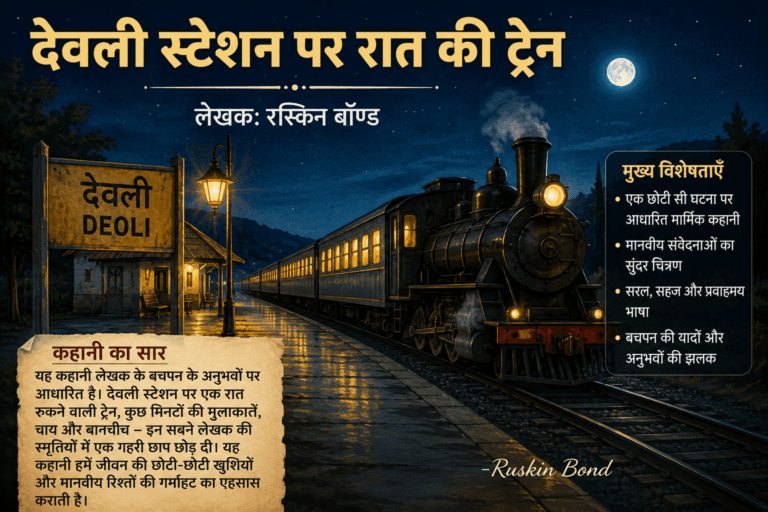
The Night Train at Deoli is a touching love story. It is not about a complete love affair but about an unspoken emotional connection between a young college student and a poor basket-selling girl.
The story teaches us that:
- Some people enter our lives only for a short time.
- Some memories remain forever.
- Not every love story reaches its destination.
- Sometimes imagination is more beautiful than reality.
The story beautifully combines love, hope, loneliness, mystery, and nostalgia.
Deep Summary (English)
The story begins with the narrator remembering his train journeys between Delhi and Dehradun during his college days. Every summer he travelled to visit his grandmother in Dehra.
During these journeys, the train always stopped for ten minutes at a lonely station called Deoli. The station was very small. There was only one platform, a station master’s office, a waiting room, a tea stall, a fruit seller, and a few stray dogs. Nobody usually got on or off the train there.
The narrator often wondered why the train stopped at such a lonely station where nothing seemed to happen. He even imagined spending a whole day there someday.
One cold morning, when he was eighteen years old, he saw a young girl selling cane baskets on the platform.
She wore old clothes and had bare feet, but she walked with dignity and grace. She had beautiful black hair, pale skin, and deep expressive eyes.
Their eyes met.
Neither of them spoke for a long time.
The narrator felt strangely attracted to her. Although he did not need a basket, he finally bought one just to continue talking to her.
Before they could speak properly, the guard blew the whistle.
The train started moving.
The girl remained standing on the platform, smiling at him until the train disappeared into the jungle.
The narrator could not forget her face.
When he reached his grandmother’s house, he became busy with family life and gradually forgot the incident.
Two months later, while returning to Delhi, he suddenly remembered the girl.
As the train entered Deoli station, he eagerly searched for her.
She was there.
She smiled immediately after seeing him.
Both were happy because they had remembered each other.
This time they talked a little.
The narrator held her hand and told her that he would come back again.
She silently nodded.
Again the whistle blew.
Again the train separated them.
This time the narrator carried her memory with him throughout the year.
When his college closed for summer vacation, he hurried to Dehra earlier than usual because he wanted to meet the girl again.
But this time she was missing.
He searched everywhere.
He asked the station master.
The station master knew nothing.
Later he asked the tea stall owner.
The tea stall owner remembered the girl but said she had stopped coming.
He did not know where she had gone.
The narrator felt heartbroken.
He planned to get down at Deoli someday and search for her.
However, he never did.
He was afraid.
He feared that reality might destroy the beautiful dream he had kept alive in his heart.
Perhaps she had married.
Perhaps she had died.
Perhaps she had moved away.
Perhaps she had forgotten him.
Even after many years, whenever the narrator passed through Deoli, he looked out of the train window, hoping to see the basket girl again.
He never stopped his journey.
Instead, he preferred to keep dreaming because hope was more beautiful than certainty.
गहन सारांश (Hindi)
यह कहानी एक युवक की स्मृतियों पर आधारित है। जब वह कॉलेज में पढ़ता था, तब हर वर्ष गर्मियों की छुट्टियों में अपनी दादी से मिलने दिल्ली से देहरादून जाता था।
रास्ते में ट्रेन देओली स्टेशन पर दस मिनट रुकती थी।
देओली एक छोटा और सुनसान स्टेशन था। वहाँ केवल एक प्लेटफॉर्म, स्टेशन मास्टर का कमरा, एक चाय की दुकान, एक फल वाला और कुछ आवारा कुत्ते थे। वहाँ कोई यात्री न चढ़ता था और न उतरता था।
नायक हमेशा सोचता था कि ट्रेन यहाँ क्यों रुकती है।
एक दिन उसने वहाँ एक गरीब लड़की को देखा, जो बेंत की टोकरियाँ बेच रही थी।
लड़की के कपड़े पुराने थे, पैर नंगे थे, लेकिन उसके चेहरे पर आत्मसम्मान और गरिमा थी।
उसकी बड़ी-बड़ी काली आँखें नायक के मन को छू गईं।
दोनों काफी देर तक बिना बोले एक-दूसरे को देखते रहे।
नायक को लड़की से अचानक एक गहरा लगाव महसूस हुआ।
हालाँकि उसे टोकरी की ज़रूरत नहीं थी, फिर भी उसने एक टोकरी खरीद ली ताकि वह उससे बात कर सके।
लेकिन तभी ट्रेन चलने लगी।
लड़की मुस्कुराती रही।
नायक खिड़की से उसे तब तक देखता रहा, जब तक स्टेशन जंगल में छिप नहीं गया।
देहरादून पहुँचकर वह व्यस्त हो गया, लेकिन दो महीने बाद वापसी के समय उसे फिर वही लड़की याद आई।
इस बार लड़की फिर प्लेटफॉर्म पर मिली।
दोनों एक-दूसरे को देखकर मुस्कुरा दिए।
बिना अधिक बातें किए भी उनके बीच भावनाओं का आदान-प्रदान हो गया।
नायक ने उसका हाथ पकड़कर कहा—
“मैं फिर आऊँगा।”
लड़की ने केवल सिर हिला दिया।
फिर ट्रेन चल पड़ी।
अगली गर्मियों में नायक बहुत उत्साह से जल्दी आया।
लेकिन इस बार लड़की वहाँ नहीं थी।
उसने स्टेशन मास्टर से पूछा।
कोई जानकारी नहीं मिली।
फिर उसने चाय वाले से पूछा।
चाय वाले ने बताया कि वह लड़की अब यहाँ नहीं आती।
लेकिन कहाँ गई—यह उसे भी नहीं पता था।
नायक बहुत दुखी हुआ।
उसने सोचा कि किसी दिन वह देओली उतरकर लड़की को खोजेगा।
लेकिन उसने कभी ऐसा नहीं किया।
क्योंकि उसे डर था कि कहीं सच जानकर उसकी खूबसूरत यादें टूट न जाएँ।
शायद लड़की की शादी हो गई होगी।
शायद वह कहीं और चली गई होगी।
शायद वह बीमार पड़ गई होगी।
शायद वह उसे भूल गई होगी।
आज भी जब वह देओली स्टेशन से गुजरता है, तो खिड़की से बाहर उसी लड़की को खोजता है।
वह कभी उतरता नहीं।
वह अपनी आशा और स्मृतियों को जीवित रखना चाहता है।
यही इस कहानी का सबसे मार्मिक और सुंदर अंत है।
Main Characters
1. The Narrator
- Sensitive
- Romantic
- Emotional
- Dreamer
- Kind-hearted
- Shy
- Nostalgic
2. Basket Girl
- Beautiful
- Simple
- Poor
- Graceful
- Quiet
- Honest
- Self-respecting
- Mysterious
3. Station Master
- Practical
- Busy
- Knows little about the girl
4. Tea Stall Owner
- Old man
- Remembers the girl
- Cannot tell where she went
5. Grandmother
- Loves the narrator
- Happy when he visits
- Later disappointed because he leaves early
Major Themes
1. Unfulfilled Love
The narrator loves the girl but never expresses his feelings fully.
2. Hope
Even after many years, he hopes to see her again.
3. Nostalgia
The story is filled with memories of youth and first love.
4. Mystery
Nobody knows what happened to the basket girl.
5. Loneliness
Both the lonely station and the lonely girl symbolize isolation.
6. Passage of Time
Time changes everything, but memories remain.
7. Beauty of Memories
Sometimes memories become more beautiful than reality.
Symbols in the Story
| Symbol | Meaning |
|---|---|
| Deoli Station | Loneliness, waiting, mystery |
| Basket Girl | Lost love, innocence |
| Train | Journey of life |
| Basket | Simple livelihood and human connection |
| Jungle | Unknown future |
| Dawn | New hope |
| Whistle | Separation |
| Window | Distance between dreams and reality |
Literary Devices
- Imagery: Beautiful descriptions of dawn, jungle, station, and the girl’s eyes.
- Symbolism: Train, station, basket, jungle.
- Personification: “Lonely platform.”
- Repetition: Repeated visits to Deoli show hope.
- Irony: He promises to return but never gathers the courage to search for her.
- Foreshadowing: The mysterious atmosphere hints that the girl will disappear.
Important Quotations with Meaning
1. “Do you want to buy a basket?”
Meaning: This simple question begins an unforgettable emotional journey.
2. “I will come again.”
Meaning: It expresses hope, love, and a promise that remains unfulfilled.
3. “She had stolen my heart with nothing but a look.”
Meaning: Love can begin silently, through a single glance.
4. “I prefer to keep hoping and dreaming.”
Meaning: Sometimes dreams are more comforting than reality.
5. “I never break my journey at Deoli.”
Meaning: The narrator chooses memory over truth because he fears disappointment.
Moral of the Story
- Some relationships are remembered not because they lasted long, but because they touched the heart deeply.
- Life is full of missed opportunities, and not every story gets a perfect ending.
- Hope and memories can remain alive even when people disappear from our lives.
- Sometimes the mystery of an unanswered question is more beautiful than knowing the truth.
The Night Train at Deoli – 50 MCQs with Answers
1. Where does the narrator usually travel every summer?
A. Delhi
B. Dehra to visit his grandmother ✅
C. Mumbai
D. Kolkata
Answer: B
2. At what time did the train reach Deoli station?
A. 7:00 a.m.
B. 10:00 p.m.
C. About 5:00 a.m. ✅
D. Noon
Answer: C
3. How many platforms did Deoli station have?
A. Two
B. Three
C. One ✅
D. Four
Answer: C
4. How long did the train stop at Deoli?
A. 2 minutes
B. 5 minutes
C. 10 minutes ✅
D. 20 minutes
Answer: C
5. What was the girl selling?
A. Flowers
B. Fruits
C. Cane baskets ✅
D. Toys
Answer: C
6. What did the narrator first say when the girl offered him a basket?
A. Yes, give me two.
B. No, I don’t want a basket. ✅
C. I have no money.
D. Come later.
Answer: B
7. Why did the narrator finally buy a basket?
A. He needed it.
B. He liked the basket.
C. He wanted to talk to the girl. ✅
D. It was very cheap.
Answer: C
8. How much did the narrator pay for the basket?
A. Fifty paise
B. One rupee ✅
C. Two rupees
D. Five rupees
Answer: B
9. What interrupted the girl’s words?
A. Rain
B. Bell and engine whistle ✅
C. Crowd
D. Tea seller
Answer: B
10. What did the narrator remember most about the girl?
A. Her dress
B. Her dark eyes and smile ✅
C. Her basket
D. Her shoes
Answer: B
11. After how many months did the narrator return?
A. One month
B. Two months ✅
C. Six months
D. One year
Answer: B
12. How did the girl react when she saw him again?
A. She ignored him.
B. She smiled. ✅
C. She cried.
D. She ran away.
Answer: B
13. Where did the girl come directly?
A. Waiting room
B. Ticket counter
C. Tea stall ✅
D. Station office
Answer: C
14. What did the narrator hold?
A. Her basket
B. Her hand ✅
C. Her shawl
D. Her bag
Answer: B
15. Where did the narrator have to go?
A. Mumbai
B. Delhi ✅
C. Kolkata
D. Jaipur
Answer: B
16. What did the girl reply?
A. I will come with you.
B. I don’t have to go anywhere. ✅
C. I am leaving tomorrow.
D. I am busy.
Answer: B
17. Why did the narrator hate the guard?
A. He shouted loudly.
B. He blew the whistle. ✅
C. He sold tickets.
D. He stopped the train.
Answer: B
18. What promise did the narrator make?
A. I will write a letter.
B. I will come again. ✅
C. I will buy more baskets.
D. I will stay there.
Answer: B
19. When he returned again, what happened?
A. The girl was waiting.
B. The girl was absent. ✅
C. The station was closed.
D. The train was late.
Answer: B
20. Who did the narrator first ask about the girl?
A. Tea seller
B. Porter
C. Station master ✅
D. Passenger
Answer: C
21. What did the station master tell him?
A. She was ill.
B. He didn’t know anything. ✅
C. She had married.
D. She had left yesterday.
Answer: B
22. What tree did the narrator notice outside the station?
A. Neem
B. Mango tree ✅
C. Banyan
D. Coconut
Answer: B
23. What did the narrator see besides the mango tree?
A. A river
B. A dusty road into the jungle ✅
C. A school
D. A temple
Answer: B
24. Who replaced the old station master?
A. His brother
B. A new station master ✅
C. Tea seller
D. Guard
Answer: B
25. Who remembered the basket girl?
A. Guard
B. Tea stall owner ✅
C. Porter
D. Driver
Answer: B
26. What did the tea seller say?
A. She got married.
B. She stopped coming. ✅
C. She went to Delhi.
D. She died.
Answer: B
27. Why couldn’t the tea seller explain further?
A. He forgot.
B. She was nothing to him. ✅
C. He was busy.
D. He was new.
Answer: B
28. What did the narrator decide?
A. Never visit again.
B. Spend a day at Deoli someday. ✅
C. Write a book.
D. Forget the girl.
Answer: B
29. Why did he never break his journey?
A. No time
B. Fear of the truth ✅
C. No money
D. Train rules
Answer: B
30. What was he afraid of?
A. Missing the train
B. Discovering the girl’s reality ✅
C. Losing money
D. Darkness
Answer: B
31. The story mainly deals with ________.
A. Adventure
B. Unfulfilled love ✅
C. War
D. Mystery only
Answer: B
32. The narrator was ______ years old.
A. 16
B. 18 ✅
C. 20
D. 22
Answer: B
33. The girl’s feet were ________.
A. Covered with shoes
B. Bare ✅
C. Wearing sandals
D. Wearing slippers
Answer: B
34. The girl’s clothes were ________.
A. New
B. Costly
C. Old ✅
D. Dirty
Answer: C
35. Which season is mentioned at the beginning?
A. Winter
B. Summer ✅
C. Rainy
D. Spring
Answer: B
36. The narrator visited his ________.
A. Uncle
B. Grandmother ✅
C. Friend
D. Cousin
Answer: B
37. Deoli station was surrounded by ________.
A. Desert
B. Jungle ✅
C. Mountains
D. Sea
Answer: B
38. The narrator bought the basket mainly because ________.
A. It was beautiful.
B. He liked the girl. ✅
C. His grandmother asked.
D. He needed it.
Answer: B
39. The narrator always looked out of the window hoping to see ________.
A. His grandmother
B. The basket girl ✅
C. The tea seller
D. The station master
Answer: B
40. Which feeling dominates the story?
A. Anger
B. Nostalgia and longing ✅
C. Fear
D. Pride
Answer: B
41. Who is the author of the story?
A. R.K. Narayan
B. Ruskin Bond ✅
C. Mulk Raj Anand
D. Khushwant Singh
Answer: B
42. The narrator’s home was in ________.
A. Delhi
B. Dehra ✅
C. Agra
D. Shimla
Answer: B
43. What does the basket symbolize?
A. Wealth
B. Love and memories ✅
C. Poverty only
D. Business
Answer: B
44. The girl mostly communicated through ________.
A. Long speeches
B. Silence and smiles ✅
C. Letters
D. Songs
Answer: B
45. The narrator compared their meeting to ________.
A. A business deal
B. Old friends meeting again ✅
C. A family reunion
D. A school function
Answer: B
46. The story ends with ________.
A. The narrator finding the girl.
B. The narrator continuing to hope. ✅
C. Their marriage.
D. The girl’s return.
Answer: B
47. The narrator preferred ________.
A. Reality
B. Hope and dreams ✅
C. Money
D. Fame
Answer: B
48. Which literary theme is strongest?
A. Patriotism
B. Lost opportunities ✅
C. Science
D. Humour
Answer: B
49. The narrator never forgot the girl because of her ________.
A. Wealth
B. Beauty and expressive eyes ✅
C. Family
D. Voice
Answer: B
50. The central message of the story is ________.
A. Always buy baskets.
B. Some memories remain beautiful because they remain incomplete. ✅
C. Never travel alone.
D. Always get off the train.
Answer: B
notice : इस article लिखने के लिए हमने west bengal sylabus के class -12 english की पुस्तक का help लिए। हमारा उद्देश्य केवल छात्रों को शिक्षित करना है। Google से गुजारिश है हमारे post को रैंक करे और छात्रों को शिक्षित करने में हमारी मदद करे।