
The Second Coming
BY WILLIAM BUTLER YEATS
The Second Coming by W. B. Yeats – Detailed Summary (About 1000 Words)
The Second Coming is one of the most famous poems written by the Irish poet William Butler Yeats. It was composed in 1919 and published in 1920, shortly after the First World War. The poem reflects the fear, uncertainty, and confusion that spread throughout Europe after the war. Millions of people had died, governments were unstable, and traditional values seemed to be disappearing. Yeats believed that the old world was collapsing and that a new and frightening age was about to begin. Through powerful symbols, biblical references, and mystical imagery, the poem presents a vision of a world falling into chaos.
The poem opens with the image of a falcon flying in widening circles, unable to hear the voice of the falconer. Literally, this describes a hunting bird flying so far away that it loses contact with the person controlling it. Symbolically, however, the falcon represents humanity, while the falconer symbolizes authority, moral guidance, religion, and social order. The loss of communication between them suggests that people have become disconnected from the values and principles that once guided their lives. Human beings no longer listen to reason, morality, or leadership. As a result, society begins to lose its balance.
Yeats then writes the famous lines, “Things fall apart; the centre cannot hold.” These words express the central idea of the poem. The “centre” represents the moral, political, and spiritual foundations that keep civilization united. When this centre becomes weak, everything begins to break apart. Governments lose control, laws become ineffective, traditions disappear, and society enters a period of instability. Yeats suggests that civilization survives only when it has a strong moral and social foundation. Once that foundation is destroyed, chaos becomes inevitable.
The next line, “Mere anarchy is loosed upon the world,” emphasizes that complete disorder has spread everywhere. Violence, bloodshed, fear, and confusion dominate human life. This reflects the terrible consequences of the First World War, which left Europe devastated. However, Yeats is not speaking only about war. He is describing a deeper collapse of civilization itself. People have lost faith in justice, religion, and humanity. Without shared values, society becomes dangerous and unpredictable.
One of the poem’s most memorable observations is found in the lines, “The best lack all conviction, while the worst are full of passionate intensity.” Yeats suggests that good, honest, and responsible people have become uncertain and inactive. They hesitate to defend what is right. At the same time, selfish, violent, and ambitious people are energetic, confident, and determined to impose their ideas on others. This imbalance creates a dangerous situation because evil gains power when good people remain silent. The poet warns that a society where the wicked are active and the virtuous are passive is heading toward disaster.
As the poem continues, Yeats feels that such terrible events must be signs of a great historical change. He begins to think that the Second Coming, the Christian belief that Jesus Christ will return to Earth, is near. Traditionally, Christians believe that Christ’s return will bring justice, peace, and salvation. However, Yeats completely transforms this expectation. Instead of seeing a divine savior, he experiences a strange and terrifying vision.
The vision comes from Spiritus Mundi, a Latin expression meaning “the spirit of the world” or the collective memory of humanity. According to Yeats, this universal spirit contains all human experiences, myths, and symbols. From this mysterious source, the poet sees an enormous creature emerging from the desert.
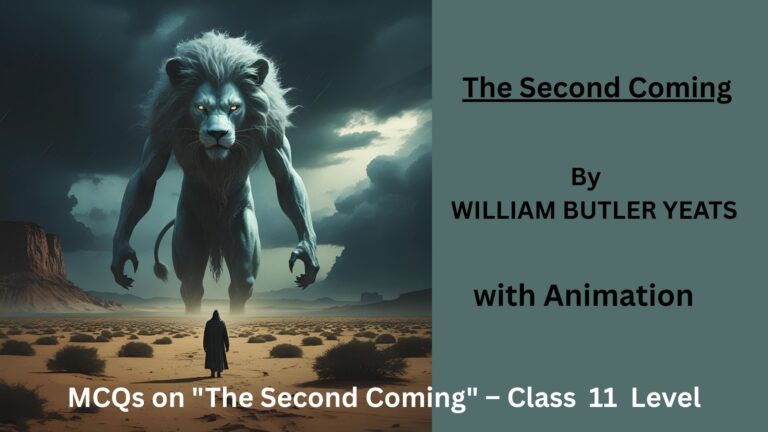
The creature has the body of a lion and the head of a man, with a cold, pitiless gaze. Around it, frightened desert birds circle in panic. This beast is not simply a monster but a symbol of a new historical era. Unlike Christ, who represented love, mercy, and hope, this creature represents violence, cruelty, and spiritual darkness. It suggests that the next age of human history may be ruled not by compassion but by fear and destruction.
After describing the beast, Yeats presents the poem’s unforgettable final image. The creature slowly moves toward Bethlehem, the town where Jesus Christ was born. This creates a shocking contrast. Bethlehem traditionally symbolizes hope, peace, and the birth of a savior. Yet the poet imagines not a holy child but a terrifying beast approaching the sacred place. The final line, “And what rough beast, its hour come round at last, slouches towards Bethlehem to be born?”, leaves the reader with an unsettling question. The poem ends without providing an answer, making the future seem uncertain and frightening.
An important idea behind the poem is Yeats’s theory of historical cycles. He believed that history does not move forward in a straight line. Instead, civilizations rise, reach their peak, decline, and are replaced by new civilizations. Every cycle lasts for about two thousand years. According to Yeats, the Christian age that began with the birth of Christ was coming to an end, and another cycle was beginning. Unfortunately, he feared that this new age would be marked by violence rather than peace.
The poem is also rich in symbolism. The falcon symbolizes humanity that has become separated from guidance. The falconer represents authority and moral order. The centre symbolizes the principles that hold society together. Anarchy represents the complete breakdown of civilization. Spiritus Mundi symbolizes the collective unconscious of humanity. The rough beast represents the terrifying forces that may dominate the future. Bethlehem symbolizes both the end of one age and the birth of another.
Although Yeats wrote the poem in response to the events following World War I, its message remains relevant today. Modern societies continue to face wars, political conflicts, terrorism, social division, and moral uncertainty. The poem reminds readers that when people abandon wisdom, justice, and compassion, society becomes unstable. It also warns that history can bring unexpected and dangerous changes if humanity fails to protect its moral values.
In conclusion, The Second Coming is a powerful prophetic poem about the collapse of civilization and the arrival of a new and uncertain age. Through vivid symbolism, biblical imagery, and philosophical ideas, Yeats expresses his fear that the world is moving toward disorder and spiritual darkness. Rather than offering hope, the poem serves as a warning that human civilization must preserve its moral foundations if it wishes to avoid destruction. Because of its universal themes and timeless message, The Second Coming remains one of the greatest and most influential poems in modern English literature.
“The Second Coming” by W.B. Yeats – विस्तृत सारांश (लगभग 1000 शब्द)
“The Second Coming” प्रसिद्ध आयरिश कवि विलियम बटलर येट्स (W. B. Yeats) द्वारा 1919 में लिखी गई और 1920 में प्रकाशित एक अत्यंत महत्वपूर्ण कविता है। यह कविता प्रथम विश्वयुद्ध (1914–1918) के बाद की भयावह परिस्थितियों, सामाजिक विघटन, नैतिक पतन तथा मानव सभ्यता के भविष्य को लेकर गहरी चिंता व्यक्त करती है। येट्स ने इस कविता में प्रतीकों (Symbols), बाइबिल के संदर्भों (Biblical References) और रहस्यवादी कल्पना (Mysticism) का प्रयोग करके यह दिखाया है कि पुरानी व्यवस्था समाप्त हो रही है और एक नया, लेकिन अत्यंत भयावह युग जन्म लेने वाला है।
कविता की शुरुआत एक बाज (Falcon) और उसके प्रशिक्षक (Falconer) के प्रतीक से होती है। बाज गोल-गोल चक्कर लगाते हुए इतना दूर चला जाता है कि वह अपने प्रशिक्षक की आवाज़ नहीं सुन पाता। इसका अर्थ केवल एक पक्षी का अपने मालिक से दूर हो जाना नहीं है, बल्कि यह पूरे समाज की स्थिति का प्रतीक है। यहाँ बाज सामान्य जनता और मानव समाज का प्रतिनिधित्व करता है, जबकि प्रशिक्षक व्यवस्था, नैतिकता, धर्म, परंपरा और नेतृत्व का प्रतीक है। जब बाज अपने प्रशिक्षक की आवाज़ नहीं सुन पाता, तो इसका संकेत है कि मनुष्य अपने नैतिक मार्गदर्शन से दूर हो गया है। लोग अब सही और गलत का अंतर भूलते जा रहे हैं। परिणामस्वरूप समाज में अनुशासन समाप्त हो जाता है और अराजकता फैलने लगती है।
इसके बाद कवि लिखते हैं कि “Things fall apart; the centre cannot hold.” यह कविता की सबसे प्रसिद्ध पंक्तियों में से एक है। इसका अर्थ है कि समाज को एकजुट रखने वाली मूल शक्तियाँ और मूल्य अब कमजोर पड़ चुके हैं। “Centre” से तात्पर्य उन नैतिक, धार्मिक, सामाजिक और राजनीतिक सिद्धांतों से है जो समाज को स्थिर बनाए रखते हैं। जब यह केंद्र कमजोर हो जाता है, तब समाज बिखरने लगता है। परिवारों में विश्वास समाप्त होने लगता है, सरकारें कमजोर हो जाती हैं, न्याय व्यवस्था पर लोगों का भरोसा कम हो जाता है और सामाजिक एकता टूटने लगती है। कवि यह बताना चाहते हैं कि सभ्यता केवल बाहरी विकास से नहीं, बल्कि मजबूत नैतिक आधार से टिकती है। यदि यह आधार नष्ट हो जाए, तो पूरी व्यवस्था धीरे-धीरे ढह जाती है।
येट्स आगे कहते हैं कि “Mere anarchy is loosed upon the world.” इसका अर्थ है कि दुनिया में पूर्ण अराजकता फैल चुकी है। युद्ध, हिंसा, हत्या, भय और अविश्वास ने मानव जीवन को घेर लिया है। प्रथम विश्वयुद्ध के बाद यूरोप में लाखों लोग मारे गए, अनेक शहर नष्ट हो गए और लोगों का भविष्य के प्रति विश्वास समाप्त होने लगा। कवि इस ऐतिहासिक स्थिति को केवल राजनीतिक संकट नहीं मानते, बल्कि इसे मानव सभ्यता के नैतिक संकट के रूप में देखते हैं। उनके अनुसार जब मनुष्य अपने आदर्शों और मूल्यों को छोड़ देता है, तब अराजकता पूरे समाज पर हावी हो जाती है।
कविता में एक और महत्वपूर्ण विचार है कि “The best lack all conviction, while the worst are full of passionate intensity.” इसका अर्थ है कि अच्छे और ईमानदार लोग आत्मविश्वास खो चुके हैं, जबकि बुरे और स्वार्थी लोग अत्यधिक उत्साह और शक्ति के साथ समाज पर प्रभाव डाल रहे हैं। यह स्थिति किसी भी समाज के लिए अत्यंत खतरनाक होती है। जब योग्य, नैतिक और शांतिप्रिय लोग मौन हो जाते हैं तथा भ्रष्ट, हिंसक और लालची लोग नेतृत्व करने लगते हैं, तब समाज का संतुलन पूरी तरह बिगड़ जाता है। येट्स इस पंक्ति के माध्यम से यह चेतावनी देते हैं कि यदि अच्छे लोग निष्क्रिय रहेंगे, तो बुराई तेजी से फैल जाएगी।
कविता के मध्य भाग में कवि को एक रहस्यमय और भविष्यसूचक दृश्य दिखाई देता है। वे कहते हैं कि उन्हें Spiritus Mundi से एक अद्भुत दृश्य प्राप्त होता है। Spiritus Mundi का अर्थ है “विश्व आत्मा” या “संपूर्ण मानव जाति की सामूहिक चेतना।” यह वह स्थान है जहाँ मानव इतिहास, मिथक और प्रतीकात्मक अनुभव संचित रहते हैं। इसी सामूहिक चेतना से कवि को भविष्य की एक भयानक झलक दिखाई देती है।
इस दृश्य में कवि एक विचित्र प्राणी को देखते हैं जिसका शरीर सिंह का है और सिर मनुष्य का। उसकी दृष्टि कठोर और निर्दयी है। यह प्राणी रेगिस्तान में धीरे-धीरे आगे बढ़ रहा है। उसके चारों ओर पक्षी भयभीत होकर उड़ रहे हैं। यह राक्षसी आकृति किसी साधारण जीव का वर्णन नहीं है, बल्कि एक ऐसे नए युग का प्रतीक है जो हिंसा, क्रूरता और विनाश से भरा होगा। यह प्राणी शक्ति, आतंक और अमानवीयता का प्रतिनिधित्व करता है। कवि संकेत देते हैं कि जिस प्रकार ईसा मसीह का जन्म प्रेम, करुणा और आशा का प्रतीक था, उसी प्रकार अब एक नया युग जन्म लेने वाला है, लेकिन उसका स्वरूप अत्यंत भयावह होगा।
कविता के अंतिम भाग में यह प्राणी धीरे-धीरे Bethlehem की ओर बढ़ता हुआ दिखाई देता है। बेथलेहम वही स्थान है जहाँ ईसा मसीह का जन्म हुआ था। सामान्यतः “Second Coming” का अर्थ ईसाई धर्म में मसीह के पुनः आगमन से जुड़ा है, जहाँ वे न्याय और शांति स्थापित करेंगे। लेकिन येट्स इस धार्मिक अवधारणा को पूरी तरह उलट देते हैं। उनके अनुसार इस बार बेथलेहम की ओर कोई उद्धारकर्ता नहीं, बल्कि एक भयानक राक्षसी शक्ति बढ़ रही है। यह संकेत देता है कि आने वाला युग प्रेम और शांति का नहीं, बल्कि हिंसा, भय और नैतिक पतन का युग हो सकता है।
येट्स का इतिहास संबंधी दृष्टिकोण भी इस कविता में स्पष्ट होता है। उनका विश्वास था कि इतिहास सीधी रेखा में आगे नहीं बढ़ता, बल्कि चक्रों (Cycles) में चलता है। जब एक युग अपनी चरम सीमा पर पहुँचकर कमजोर हो जाता है, तब उसकी जगह एक नया युग लेता है। लेकिन हर नया युग पहले से बेहतर हो, यह आवश्यक नहीं है। कभी-कभी नया युग अधिक विनाशकारी और क्रूर भी हो सकता है। “The Second Coming” इसी ऐतिहासिक परिवर्तन की भयावह संभावना को प्रस्तुत करती है।
इस कविता की भाषा अत्यंत प्रतीकात्मक और गहन है। बाज, प्रशिक्षक, केंद्र, अराजकता, रक्त, Spiritus Mundi, सिंहाकार प्राणी और बेथलेहम—ये सभी प्रतीक गहरे अर्थ रखते हैं। यही कारण है कि यह कविता केवल प्रथम विश्वयुद्ध की प्रतिक्रिया नहीं है, बल्कि हर उस समय के लिए प्रासंगिक है जब समाज नैतिक संकट, राजनीतिक अस्थिरता और मानव मूल्यों के पतन का सामना करता है। आधुनिक विश्व में बढ़ती हिंसा, युद्ध, आतंकवाद, सामाजिक विभाजन और नैतिक असंतुलन को देखते हुए यह कविता आज भी उतनी ही सार्थक प्रतीत होती है जितनी अपने समय में थी।
निष्कर्षतः, “The Second Coming” मानव सभ्यता के संकट, नैतिक पतन और इतिहास के परिवर्तनशील स्वभाव पर आधारित एक महान भविष्यसूचक कविता है। येट्स यह संदेश देते हैं कि जब समाज अपने नैतिक आधार, अनुशासन और मानवीय मूल्यों से दूर हो जाता है, तब अराजकता और विनाश अनिवार्य हो जाते हैं। कविता हमें चेतावनी देती है कि यदि मानवता समय रहते अपने मूल्यों, न्याय, करुणा और जिम्मेदारी को पुनः स्थापित नहीं करती, तो आने वाला भविष्य भय और विनाश से भरा हो सकता है। इसी गहन दार्शनिक दृष्टि, प्रभावशाली प्रतीकों और सार्वकालिक संदेश के कारण “The Second Coming” विश्व साहित्य की सबसे महत्वपूर्ण और सर्वाधिक चर्चित कविताओं में गिनी जाती है।
Section 1: Factual Recall (Q1–Q10)
What does “The falcon cannot hear the falconer” suggest?
a) Loss of connection with guiding authority ✅“Things fall apart; the centre cannot hold” means:
a) Social collapse and chaos ✅“Mere anarchy is loosed upon the world” signifies:
a) Complete disorder ✅The “blood-dimmed tide” refers to:
b) Violent upheaval and war ✅“The ceremony of innocence is drowned” implies:
b) Purity lost to chaos ✅Who lacks conviction in the poem?
c) The best ✅Who is “full of passionate intensity”?
d) The worst ✅“Surely some revelation” means:
a) A significant event is imminent ✅“Spiritus Mundi” refers to:
c) A collective universal spirit ✅The beast has the body of a _____ and head of a _____.
a) Lion — Man ✅
Section 2: Inference & Interpretation (Q11–Q20)
The expanding “gyre” symbolizes:
b) Historical cycles and decline ✅The “rough beast” approaching Bethlehem represents:
c) A menacing new age ✅“Twenty centuries of stony sleep” refer to:
b) The Christian era ✅The “rocking cradle” implies:
b) A terrifying rebirth ✅The desert birds symbolize:
c) Nature’s silent indictment ✅The tone of the poem is:
d) Apocalyptic and foreboding ✅Yeats warns about the collapse of:
c) Moral and political order ✅The poem reflects Yeats’s belief in:
a) Historical cycles ✅The “Second Coming” alludes to:
c) Biblical apocalypse ✅Yeats’s prophetic vision is triggered by:
a) The chaos all around ✅
Section 3: Vocabulary in Context (Q21–Q30)
“Gyre” means:
b) Spiral or vortex ✅“Loosed” means:
a) Set free ✅“Dimmed” means:
b) Obscured ✅“Ceremony” here means:
b) Ritual of innocence ✅“Revelation” means:
a) Divine disclosure ✅“Troubles my sight” means:
c) Disturbs poet’s vision ✅“Blank and pitiless” eyes indicate:
b) Harsh indifference ✅“Slouches” means:
a) Moves awkwardly ✅“Bethlehem” refers to:
c) Christ’s birthplace ✅“Spiritus Mundi” literally means:
b) Spirits of the world ✅
Section 4: Assertion–Reasoning (Q31–Q40)
A: The poem is apocalyptic.
R: It warns of a looming destructive era.
✅ Both true, R explains AA: The falcon falters.
R: Chaos severs bond between authority and society.
✅ Both true, R explains AA: “Blood-dimmed tide” is symbolic.
R: References violent historical upheavals.
✅ Both true, R explains AA: “Rough beast” implies creation.
R: Symbolizes something destructive being born.
✅ Both true, R explains AA: Yeats rejects Christianity.
R: He fears a new, cruel spiritual era.
✅ Both true, R explains AA: The setting is war-time.
R: Poem reflects post WWI anxiety.
✅ Both true, R explains AA: The centre cannot hold.
R: It means institutions are collapsing.
✅ Both true, R explains AA: The beast slouches towards Bethlehem.
R: This is a hopeful sign.
❌ False, doesn’t explainA: The falcon hears the falconer.
R: Peace still exists.
❌ Both falseA: “Spiritus Mundi” is universal unconscious.
R: It triggers apocalyptic vision.
✅ Both true, R explains A

🔥 Special Amazon Offer!
Hurry! Limited stock available.
Section 5: Higher-Order Analysis (Q41–Q50)
The “Second Coming” implies:
c) The birth of a new age ✅The poem’s tone is:
a) Dark and ominous ✅Yeats views history as cycles of:
b) Civilizational rise and fall ✅The beast’s approach signals:
d) Spiritual upheaval ✅The “centre” losing hold signifies:
a) Breakdown of moral/religious foundations ✅The poem reflects post-WWI:
b) Disillusionment ✅The Bible imagery shows Yeats’s:
c) Deep cultural roots ✅The poem belongs to Modernist tradition because of:
d) Fragmented imagery and bleak vision ✅Yeats warns that humanity is nearing:
a) A terrifying metamorphosis ✅The final image suggests that:
c) We face a new, darker epoch ✅
notice : इस article लिखने के लिए हमने west bengal sylabus के A Realm of English B selection prose /poetry/play , class -11 की पुस्तक का help लिए। हमारा उद्देश्य केवल छात्रों को शिक्षित करना है। Google से गुजारिश है हमारे post को रैंक करे और छात्रों को शिक्षित करने में हमारी मदद करे।